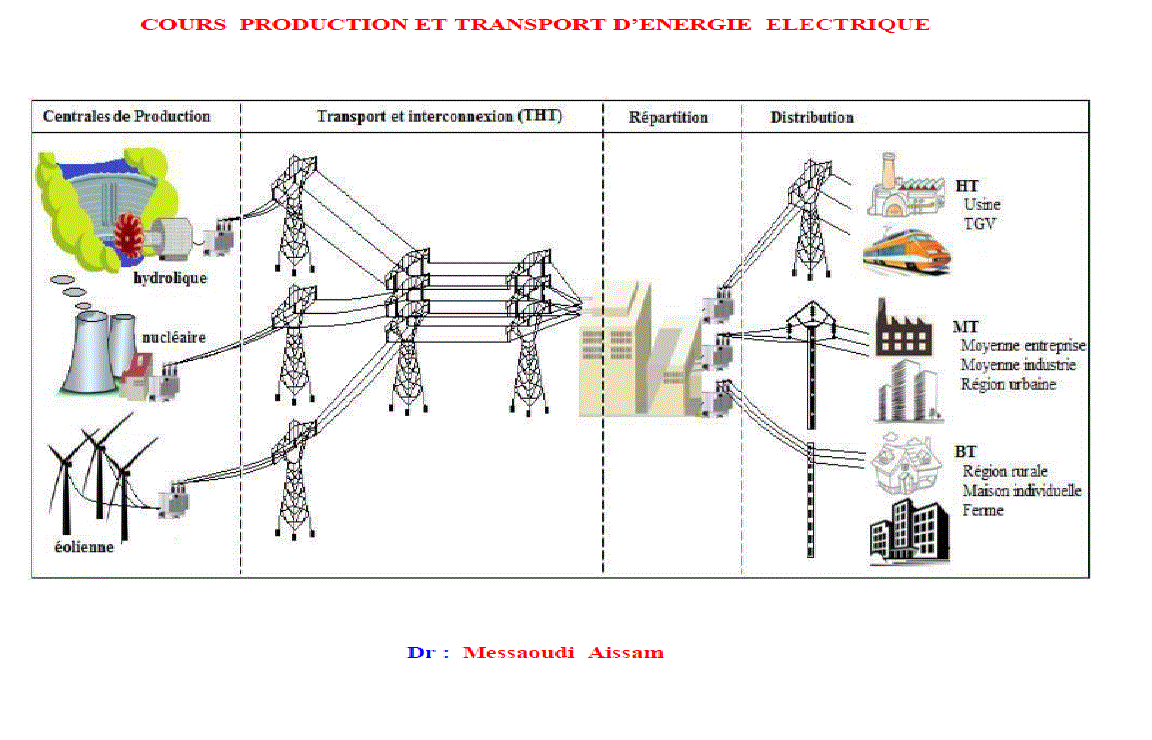
Ce document constitue un support de cours pour des étudiants en 2 en Ingénieur Génie Mécanique qui est donner aux étudiants l'ensemble des connaissances de base de la matière de production et transport d'énergie électrique et Sensibiliser les étudiants aux questions énergétiques mondiales. Donner les connaissances générales sur les principaux systèmes de production et de transport d’énergie
- Enseignant: Aissam Messaoudi
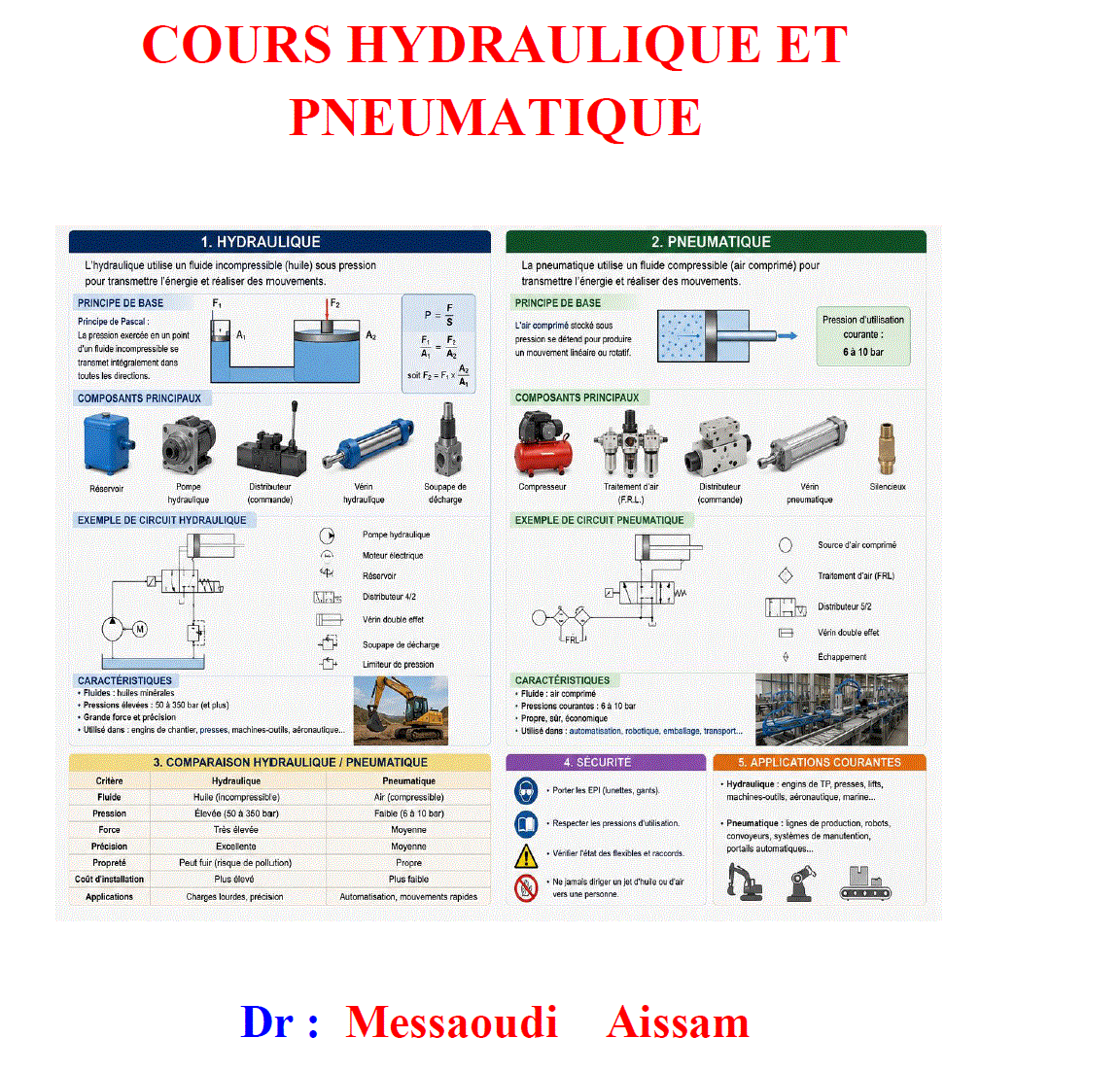
L’objectif du programme
est de soumettre aux étudiants un ensemble de connaissances indispensables et
nécessaires pour la compréhension physique de l’essentiel des systèmes
hydrauliques et pneumatiques.
- Enseignant: Aissam Messaoudi
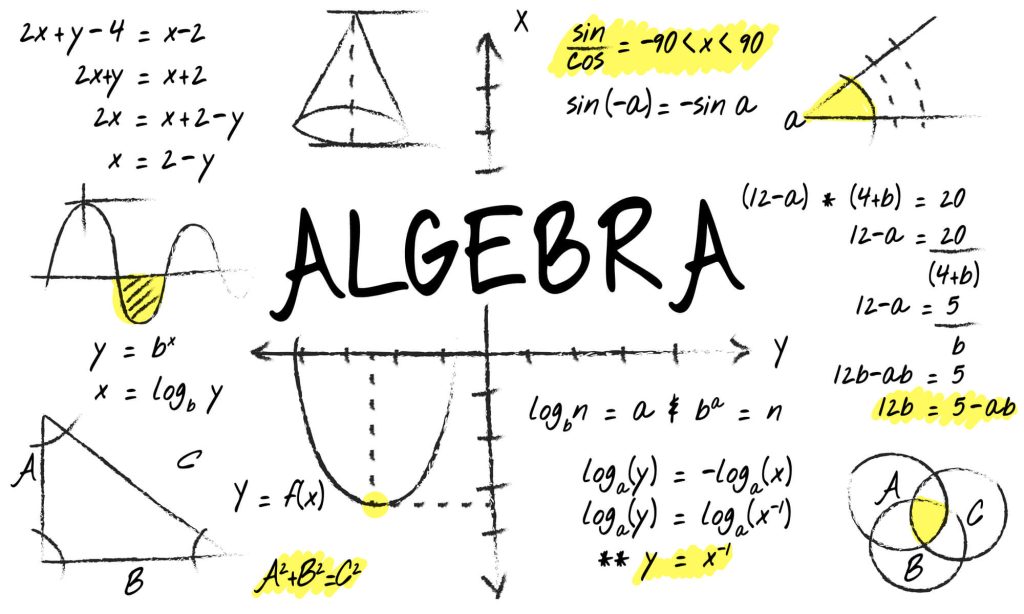
This course introduces first-year engineering students (Mechanical Engineering, Civil Engineering, and Process Engineering) to the fundamental concepts of algebra that form the foundation of advanced mathematical and engineering studies.
Throughout the semester, students will develop rigorous mathematical
reasoning, strengthen their problem-solving skills, and explore
essential algebraic structures used in various engineering applications.
The course is organized into four main chapters :
-
Logic and Mathematical Reasoning
Introduction to propositions, logical operators, quantifiers, methods of proof, and mathematical reasoning techniques. -
Sets, Binary Relations, and Functions
Fundamental set operations, Cartesian products, types of relations, equivalence relations, orders, and the concept of functions and mappings. -
Algebraic Structures
Study of groups, rings, fields, and other basic algebraic systems relevant to mathematics and engineering. -
Complex Numbers
Representation of complex numbers, algebraic and geometric interpretations, complex conjugation, and applications.
By the end of this course, students will acquire the essential algebraic foundations needed for upcoming courses in analysis, linear algebra, mechanics, and other engineering subjects.
- Enseignant: meriem saker
Objectives of Studying Electrotechnics
-
Understand Electrical Circuits
-
Understand Ohm’s law and Kirchhoff’s laws.
Analyse DC and AC circuits using systematic methods.
Solve circuit problems using network theorems.
-
Circuits in single phase and 3-phase
- Analyze single-phase and three-phase systems: Work and power
4. Transformers
5.DC and AC Electrical Machines
- Enseignant: Ali Guessam
The final objectives of studying control systems (for students) focus on building both theoretical understanding and practical engineering skills needed to analyze and design real systems.
- Understand System Behavior
- Model Real-World Systems using Differential equations and transfer functions.
- Analyze Stability and Performance
- Enseignant: Ali Guessam
Analysis 1 is a fundamental mathematics course designed to provide engineering students with a solid understanding of single-variable calculus. The course focuses on the rigorous study of limits, continuity, derivatives, as well as their applications in engineering problems. Students learn how mathematical models are built and how calculus is used to analyze and solve real-world situations related to mechanical systems and process engineering.
The course covers the following key topics:
-
Real numbers and functions
-
Limits and continuity
-
Differentiation rules and technique
- Enseignant: Heddi Kaddouri